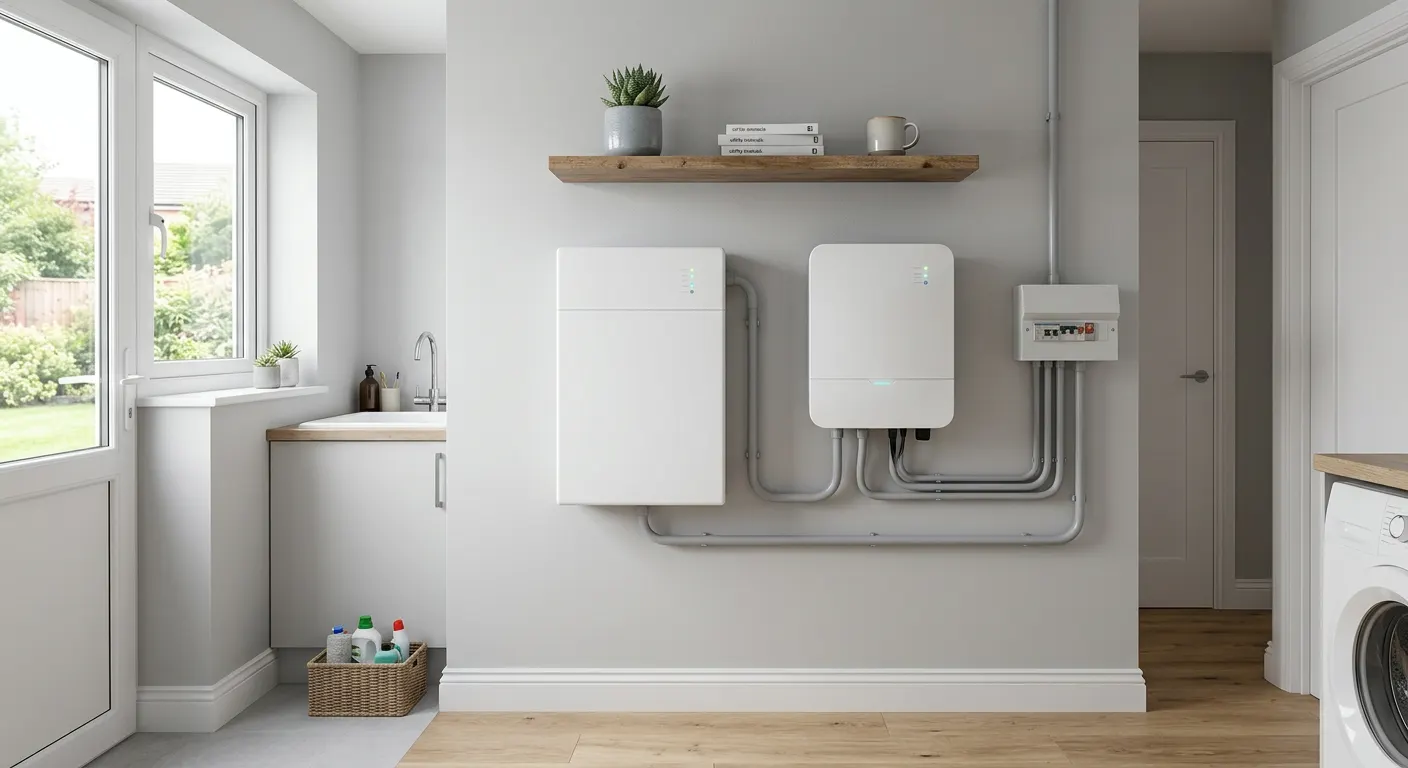
Battery retrofits
Can I add a battery to my existing solar panels?
Yes, in most cases you can add a battery to existing solar panels. If your inverter is already a hybrid model, the battery connects directly. If not, we fit a dedicated battery inverter alongside your current setup. The battery stores surplus generation so you use your own solar in the evening and through darker winter months.
If you already have solar panels on your Inverness or Highland property, adding a battery is one of the most effective upgrades you can make. Your panels are already generating electricity — the question is how much of it you actually use. A battery stores the surplus so you use it yourself instead of exporting it to the grid at a low rate and buying it back in the evening at a higher one. We retrofit batteries to existing solar systems across IV1, IV2, IV3 and the surrounding Highland postcodes, using the same Hanchu LiFePO4 battery we install in our standard systems.
Key facts
- A battery can be added to most existing solar panel systems.
- If you have a hybrid inverter, the battery connects directly.
- If you have a string inverter, an AC-coupled battery is fitted alongside it.
- Battery: Hanchu LiFePO4.
- 10-year battery warranty included.
- We install through MCS-certified partners.
- Interest-free credit up to £30,000, subject to status.
Last updated: November 2026
Get your quote
No obligationNo obligation. Our installer partner calls within 2 hours.
Can any existing solar system take a battery?
Most domestic solar installations in the Highlands can have a battery added, but the approach depends on what is already in place. If your system was installed with a hybrid inverter — one designed to manage both panels and storage — adding a battery is straightforward: the battery connects to the inverter and the system is configured to charge from surplus solar. If your existing inverter is a standard string inverter without battery capability, you do not need to replace it. An AC-coupled battery with its own built-in inverter is fitted alongside your current setup. The battery monitors your generation and consumption, charging from surplus solar and discharging when your home needs power. Either way, the panels you already have keep working exactly as before — the retrofit is additive, nothing is removed or wasted.
A survey confirms which route applies to your property and whether any minor electrical work is needed to integrate the battery safely. Inverness has a mix of traditional slate roofs (Victorian and Edwardian stone-built homes in Crown, Dalneigh, Hilton), modern concrete tile (post-war estates and new-builds in Culloden, Westhill, Inshes), and some corrugated metal on older agricultural properties. Slate roofs often require specialist mounting brackets to avoid cracking. South-facing pitches of 30–40 degrees are ideal but east–west splits work well for self-consumption. Our installer partner checks the existing wiring, consumer unit, and generation meter as part of that survey.
Existing panels
Your current solar panels stay in place and keep generating exactly as before.
Added storage
A Hanchu LiFePO4 battery is fitted to store surplus generation for evening use.
Smarter use
The system charges from surplus solar and discharges when your home needs power.
Do I need to replace my existing inverter?
Not necessarily. If your current inverter is a hybrid model — increasingly common on systems installed in recent years — the battery connects directly and no replacement is needed. If your inverter is a standard string inverter, the simplest and most cost-effective approach is to add an AC-coupled battery with its own integrated inverter. This sits alongside your existing setup and does not require changing any of your current hardware.
In some cases, homeowners choose to upgrade to a hybrid inverter when adding a battery, particularly if their existing inverter is nearing the end of its expected life or if they want the efficiency benefits of DC coupling. Our installer partner assesses your current system during the survey and recommends the approach that makes the most sense for your equipment and budget. We install through MCS-certified partners, so any changes meet the recognised industry standard for quality and safety.
You can read about our standard system specification, including the Hanchu ESS hybrid inverter, on our solar panels page.
How does a battery improve self-consumption?
Without a battery, any solar you generate but do not use immediately flows to the grid. You receive 12 pence per kWh for that exported energy through an export tariff. The issue is that buying electricity back from the grid in the evening costs considerably more per kWh than you earn from exporting it. A battery closes that gap. Instead of selling your surplus cheaply and buying power back at a higher price, the battery stores your daytime generation so you use it yourself after dark.
This is called import displacement: every kWh you store and use yourself is one fewer kWh you import from the grid at the higher rate. The more of your own generation you consume, the less you depend on imported electricity — and the more value you get from the panels you have already paid for. To estimate how much a battery could improve your self-consumption, try our battery savings calculator.
Why does retrofitting a battery matter in the Highlands?
The Highlands amplify the case for battery storage. Inverness sees over 18 hours of daylight in June, meaning a well-oriented solar system generates well above typical household demand for much of the day. Without storage, that surplus is exported. In December, the same property sees around seven hours of low, often overcast daylight and generates very little. A battery lets you carry summer surplus into the evening and, combined with strategic charging, into the darker months.
Many properties in the surrounding Highlands are off the gas grid, making solar-plus-battery or solar-plus-heat-pump combinations particularly relevant. These properties often have higher energy costs and benefit most from self-generation. For off-gas properties, the value of self-generated electricity is higher because the heating fuels it displaces — oil, LPG, or electric — cost more per unit than mains gas. Adding a battery to an existing solar system in the Highlands is, for many homes, the single change that turns panels from a daytime generation asset into a round-the-clock self-consumption system. For a deeper look at why storage matters here, see our battery storage in the Highlands page.
Which battery do we use for retrofits?
For battery retrofits, we use the Hanchu LiFePO4 battery — the same unit we install in our standard solar-plus-battery systems. It uses lithium iron phosphate chemistry, which is stable, safe, and long-lasting, with a 95 per cent depth of discharge, approximately 8,000 cycles, and an approximately 22-year manufacturer design life at one cycle per day. The battery comes with a 10-year warranty and is paired with a Hanchu ESS hybrid inverter where the existing system supports DC coupling, or an AC-coupled configuration where the existing inverter is retained.
Whether you are adding a battery to panels we installed or to a system put in by another company, the hardware and warranty are the same. We install through MCS-certified partners, and the installation is covered by an insurance-backed guarantee through the Independent Warranty Association. You can read the full warranty details on our warranties and guarantees page.
Battery
Hanchu LiFePO4 — 95% depth of discharge, ~8,000 cycles, ~22-year design life.
Battery warranty
10-year battery warranty
Insurance-backed guarantee
Insurance-backed guarantee through the Independent Warranty Association, covering the system if the installing company ceases trading
Inverter
Hanchu ESS hybrid inverter for DC coupling, or AC-coupled alongside your existing inverter.
Is it worth adding a battery to existing solar?
For most Highland homes with existing solar panels, yes. The panels are already generating — the question is how much of that generation you actually use. Without a battery, you export the surplus at a relatively low rate and buy it back at a higher one. With a battery, you keep and use that energy yourself. The improvement in self-consumption is the main benefit, and it is most pronounced in the Highlands because of the wide gap between summer generation and winter demand.
Interest-free credit up to £30,000, subject to status. To find out what a battery retrofit would involve for your specific system, fill in the form on this page and our installer partner will arrange a no-obligation survey. You can also read about the full installation process on our how it works page.
Get a battery retrofit quote
The best way to find out what adding a battery involves for your property is a no-obligation survey. Our installer partner inspects your existing solar system, confirms which coupling approach applies, and provides a written quote. Fill in the form at the top of this page, or call us directly.
Frequently asked questions
Can I add a battery to solar panels installed by another company?
Yes. We can add a battery to a solar system installed by another company, provided the existing panels and wiring are in safe working order. Our installer partner inspects your current setup during the survey and confirms what is needed to integrate the battery. The Hanchu LiFePO4 battery and 10-year warranty apply regardless of who installed your original panels.
Will adding a battery affect my existing solar panel warranties?
Adding a battery should not affect your existing panel warranty, because the retrofit is additive — nothing about your current panels is changed or removed. The battery comes with its own 10-year warranty, and the installation is covered by an insurance-backed guarantee through the Independent Warranty Association. Our installer partner confirms any warranty implications during the survey.
How long does a battery retrofit take?
A typical battery retrofit takes one to two days on site, depending on whether your existing inverter is hybrid or needs an AC-coupled battery alongside it. The survey, SSEN notification if required, and scheduling happen before installation day. Our installer partner gives you a clear timeline as part of your quote.
Can I add a battery if I have a string inverter?
Yes. If your existing inverter is a standard string inverter without battery capability, an AC-coupled battery with its own built-in inverter is fitted alongside your current setup. Your existing inverter and panels keep working exactly as before, and the battery monitors your generation to charge from surplus solar. No replacement of your current hardware is required.
Does adding a battery change my export payments?
Adding a battery does not remove your eligibility for export payments, but it does change how much you export. Instead of sending surplus solar to the grid at 12 pence per kWh, the battery stores it for you to use yourself. Because importing electricity costs more per kWh than you earn from exporting, using your own stored energy is worth more than exporting it.
Is finance available for a battery retrofit?
Interest-free credit up to £30,000, subject to status. Finance covers the battery, any inverter changes, and installation labour. You can discuss the options with our installer partner during the quoting process, and there is no obligation to use finance if you prefer to pay upfront.
Learn more about battery storage and solar
- Battery storage in the Highlands — why storage matters for Highland homes and the full battery specification.
- Solar panel systems and specification — panels, inverter, and battery details for our standard install.
- Warranties and guarantees explained — what is covered by the battery warranty and insurance-backed guarantee.
- Battery savings calculator — estimate how much a battery could improve your self-consumption.
- How the installation process works — from first call to switch-on for Inverness and Highland properties.
Last updated November 2026