Cost guide
How much do solar panels cost in Inverness in 2026?
A standard domestic solar-plus-battery system in Inverness costs £12,500–£13,500 fully installed through our MCS-certified partner, including 12 × AIKO Comet 500 W black-on-black, a Hanchu ESS hybrid inverter, and battery storage. Prices vary with roof type, property access, and system size across IV postcodes.
Key facts
- Standard system price: £12,500–£13,500 fully installed
- Includes 12 × AIKO Comet 500 W black-on-black
- Inverter: Hanchu ESS hybrid inverter
- Battery: Hanchu LiFePO4 (95% depth of discharge, approximately 8,000 cycles, approximately 22-year manufacturer design life at one cycle per day)
- Included as standard
- 30-year performance warranty (above 90% output at year 30, approximately 0.4% per year degradation)
- 10-year inverter warranty and 10-year battery warranty
- We install through MCS-certified partners
Last updated: November 2026
The headline price for a typical Inverness home covers a complete system: panels, hybrid inverter, battery storage, mounting, scaffolding, and installation labour. It does not include optional extras like EV charging or heat-pump integration, which are priced separately after a survey.
Interest-free credit up to £30,000, subject to status. To get an exact figure for your property, use the quote form on this page and our installer partner will arrange a no-obligation survey at your Inverness address.
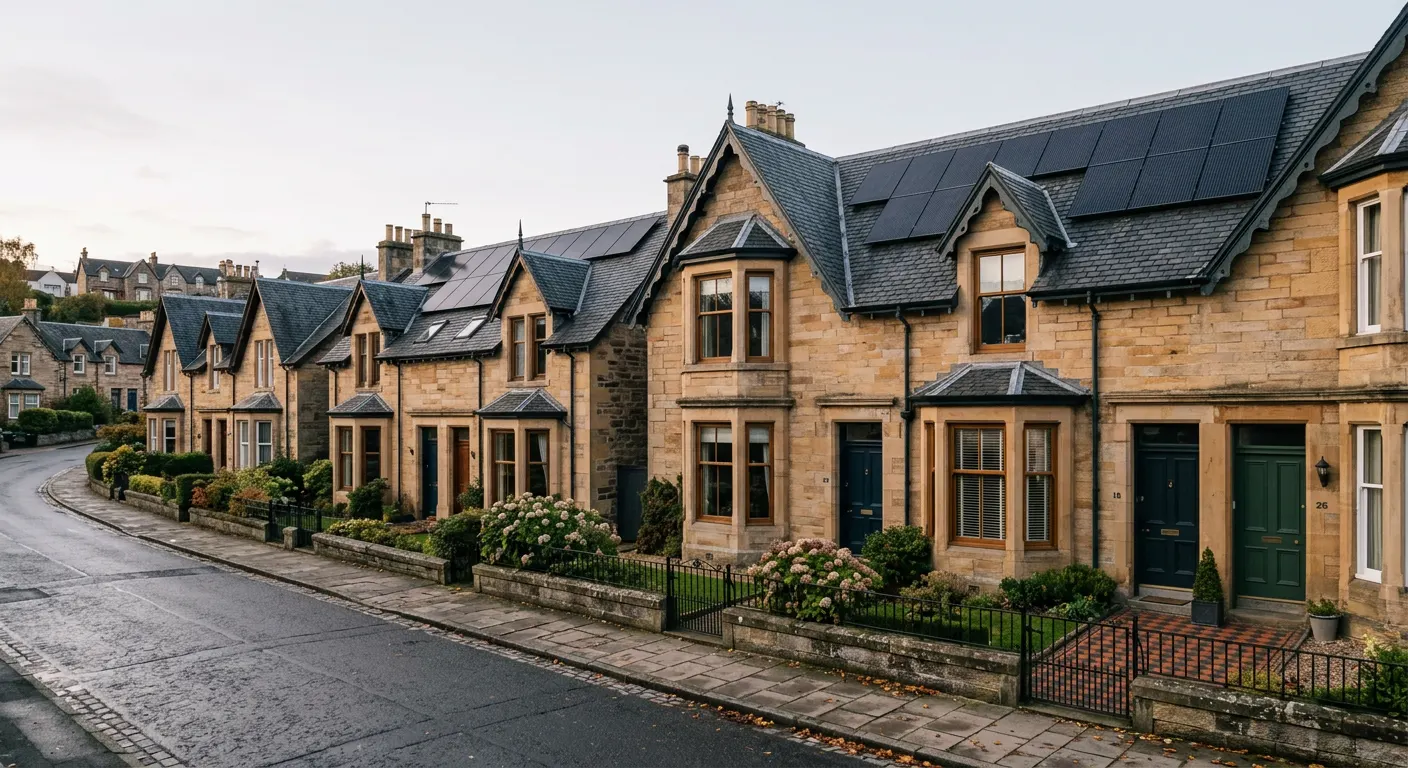
We cover all Inverness postcodes including IV1, IV2, and IV3, plus surrounding Highland areas. IV1–IV3 cover Inverness city centre, Crown, Dalneigh, Hilton, Culloden and Westhill. Whether you live in a Victorian sandstone terrace in Crown, a new-build in Westhill, or a rural property outside the city, the quote you receive is based on your actual roof and energy use, not a one-size-fits-all estimate.
Get your quote
No obligationNo obligation. Our installer partner calls within 2 hours.
What does the standard Inverness solar system include?
Our standard domestic system for Inverness homes is built around 12 × AIKO Comet 500 W black-on-black, paired with a Hanchu ESS hybrid inverter and Hanchu LiFePO4. Included as standard is included on every install, protecting your investment from nesting damage common in Highland roofs.
The full warranty package matters when comparing quotes. You get 30-year performance warranty (above 90% output at year 30, approximately 0.4% per year degradation), 10-year inverter warranty, and 10-year battery warranty. On top of that, an insurance-backed guarantee through the independent warranty association, covering the system if the installing company ceases trading. This means your system remains covered even if circumstances change, giving you long-term confidence in the investment.
When you see a significantly lower quote elsewhere, it is worth checking what has been omitted. Some companies exclude battery storage from their headline price, or skip bird proofing, or offer shorter inverter warranties. Our standard price includes everything listed above with no hidden extras on the standard system.
Panels
12 × AIKO Comet 500 W black-on-black
Inverter
Hanchu ESS hybrid inverter
Battery
Hanchu LiFePO4
Insurance
Insurance-backed guarantee through the Independent Warranty Association, covering the system if the installing company ceases trading
Inverter warranty
10-year inverter warranty
Bird proofing
Included as standard
Why do solar costs in Inverness differ from the UK average?
Inverness sits at a latitude that changes the economics of solar. Inverness receives around 3.1–3.3 peak sun hours per day annually. Summer days are exceptionally long (over 18 hours of daylight in June), partly compensating for shorter winter days. The east-facing Highland capital gets less rainfall than the west coast, which helps panel performance. A typical 4 kWp system in Inverness generates around 3,400–3,600 kWh per year. The long summer days of the Highlands mean a system can overproduce in June and July, making battery storage particularly valuable for carrying that surplus into the evening and through shorter winter days.
Installation costs in Inverness can also be affected by roof type. Inverness has a mix of traditional slate roofs (Victorian and Edwardian stone-built homes in Crown, Dalneigh, Hilton), modern concrete tile (post-war estates and new-builds in Culloden, Westhill, Inshes), and some corrugated metal on older agricultural properties. Slate roofs often require specialist mounting brackets to avoid cracking. South-facing pitches of 30–40 degrees are ideal but east–west splits work well for self-consumption. Traditional slate roofs in areas like Crown and Dalneigh sometimes need specialist mounting brackets, while modern concrete tile estates in Culloden and Westhill are more straightforward. These differences in mounting hardware and labour time are part of why a survey is needed before a final price is confirmed.
Many properties in the surrounding Highlands are off the gas grid, making solar-plus-battery or solar-plus-heat-pump combinations particularly relevant. These properties often have higher energy costs and benefit most from self-generation. For off-gas properties, pairing solar with a battery is especially worthwhile because it reduces reliance on more expensive heating fuels and stores the summer surplus for winter evenings.
What factors can change the final price?
Several variables affect the final quote for an Inverness property. The size of the system is the biggest factor: a larger roof can accommodate more panels, increasing generation but also cost. The battery capacity you choose also matters, as does the complexity of the roof and any scaffolding requirements.
Properties with difficult access, such as steeply pitched roofs, multiple roof planes, or chimneys that need working around, may require more scaffolding or additional labour time. Listed buildings or homes in conservation areas can also incur planning application fees through The Highland Council, though most standard Inverness homes avoid this entirely under permitted development.
If you want to add an EV charger, a heat pump, or additional battery capacity, these are quoted as optional extras after your survey. The standard system price covers everything needed for a working solar-plus-battery installation tailored to a typical Inverness home.
Do I need planning permission for solar in Inverness?
Most Inverness homes do not need planning permission for solar panels. Most domestic roof-mounted solar does not need planning permission under permitted development rights. Exceptions: listed buildings (Highland Council has over 1,700), conservation areas (Inverness city centre, Crown, Culduthel), and buildings in the Cairngorms National Park boundary. Applications to The Highland Council planning department required in these cases.
If your property is in a conservation area or is listed, The Highland Council will need to approve the installation before work begins. Our installer partner handles the application as part of the process where required, so you do not need to navigate the planning system on your own.
Conservation areas in Inverness include parts of the city centre, Crown, and Culduthel. If you are unsure whether your home falls within one, we can check this as part of the initial survey and advise on the next steps.
How does the SSEN grid connection affect cost and timing?
G98/G99 application via SSEN before installation. Systems up to 3.68 kW single-phase typically qualify for simplified G98 notification; larger systems require G99 engineering study, which can take 6–12 weeks in the Highlands due to grid constraints.
The DNO for Inverness is SSEN (Scottish and Southern Electricity Networks). Most standard domestic systems fall under the G98 notification route, which is quicker and has no application fee. Larger systems requiring G99 can add several weeks to the timeline, which is factored into your installation schedule rather than charged as an extra. This is one reason why starting the process sooner rather than later is sensible if you want your system installed by a specific date.
The grid connection does not typically add to the cost of a standard system, but it can affect the timeline. We will advise you at quote stage which route applies to your property and what to expect.
What about finance and spreading the cost?
Interest-free credit up to £30,000, subject to status. This allows you to spread the cost of a full £12,500–£13,500 system without paying interest, subject to status and affordability.
We install through MCS-certified partners, so your installation meets the recognised industry standard for quality and eligibility. Ask about current finance terms when you request your quote, and we will walk you through the options available for your circumstances.
Spreading the cost can make a solar-plus-battery system accessible without a large upfront payment. The finance terms, including the deposit and repayment period, are confirmed as part of your quote once the survey is complete and the system size is agreed.
Get an exact price for your home
The figures on this page are for our standard system. Your actual quote depends on your roof, property type, and energy use. Fill in the form at the top of this page, or call us directly, and our installer partner will arrange a no-obligation survey at your Inverness property.
Frequently asked questions
What is the average cost of solar panels in Inverness in 2026?
A standard domestic solar-plus-battery system in Inverness costs £12,500–£13,500 fully installed. This includes 12 × AIKO Comet 500 W black-on-black, a Hanchu ESS hybrid inverter, and a Hanchu LiFePO4, plus included as standard. The exact price depends on your roof type, access, and whether scaffolding is needed for properties in IV1, IV2, or IV3.
Do Inverness homes generate enough solar to justify the cost?
Inverness receives around 3.1–3.3 peak sun hours per day annually. Summer days are exceptionally long (over 18 hours of daylight in June), partly compensating for shorter winter days. The east-facing Highland capital gets less rainfall than the west coast, which helps panel performance. A typical 4 kWp system in Inverness generates around 3,400–3,600 kWh per year. Inverness receives less rainfall than the west coast, which helps keep panels clean and performing. Long summer daylight hours mean a well-sized system can generate well above the household daytime demand from May to August.
Is finance available for solar panels in Inverness?
Interest-free credit up to £30,000, subject to status. This spreads the cost of a full solar-plus-battery system over a set term with no interest charged. Ask us about current terms when you request a quote.
What warranties come with a solar system in Inverness?
Our standard system includes 30-year performance warranty (above 90% output at year 30, approximately 0.4% per year degradation), 10-year inverter warranty, and 10-year battery warranty. An insurance-backed guarantee through the independent warranty association, covering the system if the installing company ceases trading is also included.
Do I need planning permission for solar panels in Inverness?
Most domestic roof-mounted solar does not need planning permission under permitted development rights. Exceptions: listed buildings (Highland Council has over 1,700), conservation areas (Inverness city centre, Crown, Culduthel), and buildings in the Cairngorms National Park boundary. Applications to The Highland Council planning department required in these cases.
How does the grid connection work for Inverness homes?
G98/G99 application via SSEN before installation. Systems up to 3.68 kW single-phase typically qualify for simplified G98 notification; larger systems require G99 engineering study, which can take 6–12 weeks in the Highlands due to grid constraints.
Which Inverness postcodes do you cover?
IV1–IV3 cover Inverness city centre, Crown, Dalneigh, Hilton, Culloden and Westhill. We also cover Postcodes outside Inverness city include the Black Isle, Beauly, Dingwall, Nairn, Aviemore and surrounding Highland areas.
Learn more about solar in Inverness
- Full solar panel system specification — panel, inverter, and battery details for our standard Inverness install.
- Battery storage in the Highlands — why a battery matters for Inverness homes with long summer days and short winter ones.
- Warranties and guarantees explained — what is covered by the panel, inverter, battery, and insurance-backed guarantees.
- Solar panels in Inverness city (IV1–IV3) — postcode-specific guidance for the city centre and surrounding areas.
- How the installation process works — from first call to switch-on for Inverness and Highland properties.