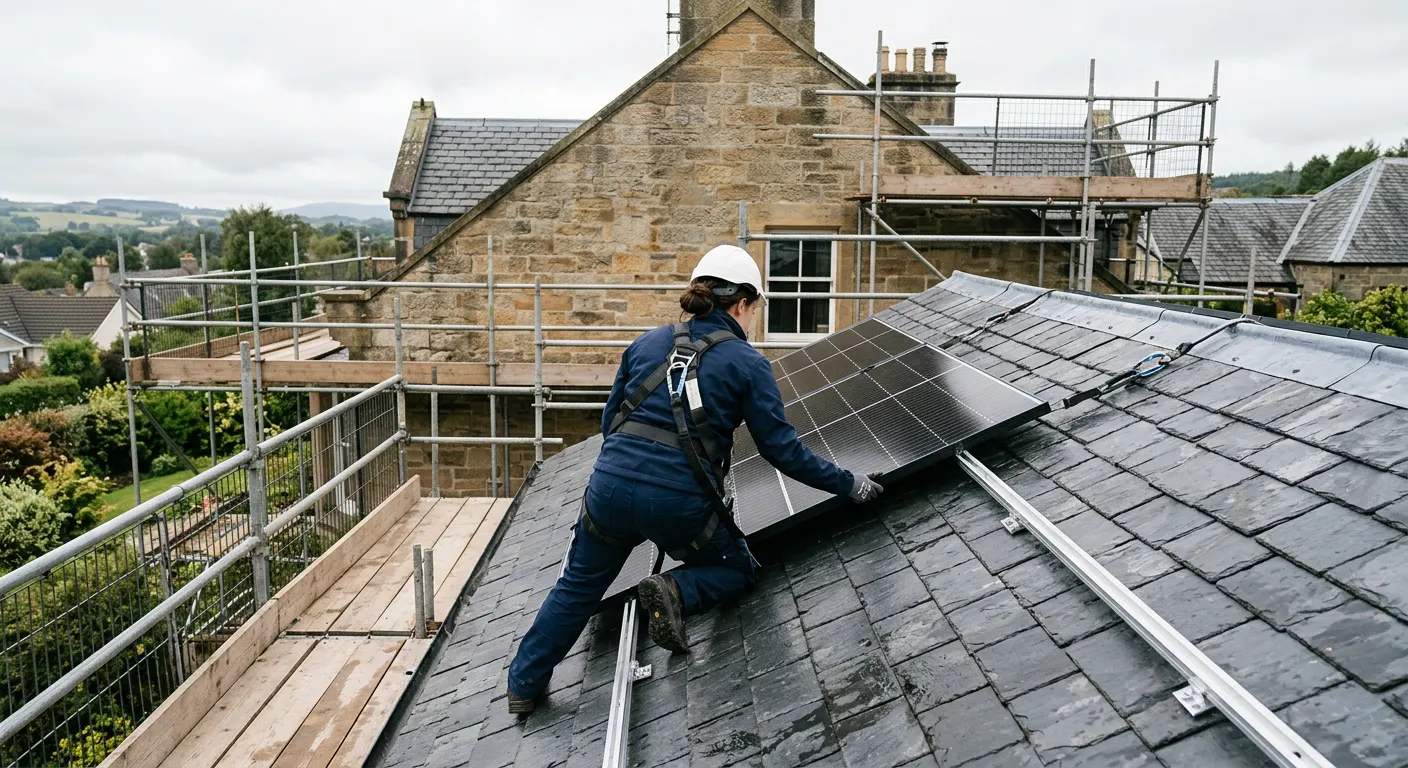
Choosing an installer
How do I choose a solar installer in Inverness?
Choose a solar installer in Inverness by checking MCS certification, TrustMark registration, and an insurance-backed guarantee. Always get a written quote after a proper survey, ask about warranties on panels, inverter, and battery, and pick a team with local knowledge of Highland roofs, weather, and SSEN grid connections.
Key facts
- Check MCS certification — the industry standard for renewable installers.
- Confirm TrustMark registration for government-endorsed quality assurance.
- Insist on an insurance-backed guarantee in case the installer ceases trading.
- Get a written, itemised quote after a proper survey — not a phone estimate.
- Choose an installer with Highland roof and SSEN grid experience.
- We install through MCS-certified partners.
- Interest-free credit up to £30,000, subject to status.
Last updated: November 2026
Choosing the right solar installer is the single most important decision you will make when going solar in Inverness. The quality of the installation affects how much energy your system generates, how long it lasts, and how well it is protected if something goes wrong. A well-chosen installer gives you confidence in every one of those areas.
We install through MCS-certified partners, and this page sets out exactly what to look for when comparing installers in Inverness. Interest-free credit up to £30,000, subject to status. To get a written quote for your property, use the form on this page and our installer partner will arrange a no-obligation survey at your Inverness address.
Get your quote
No obligationNo obligation. Our installer partner calls within 2 hours.
Why does MCS certification matter when choosing a solar installer?
MCS (Microgeneration Certification Scheme) is the industry standard for renewable energy installers in the UK. An MCS-certified installer has been independently assessed on their technical competence and quality management, and the products they fit have been tested to recognised standards. For Inverness homeowners, choosing an MCS-certified installer means your system is installed to a benchmarked standard and your MCS certificate is registered on completion.
We install through MCS-certified partners, so every system we arrange meets this standard. An MCS certificate also matters if you ever want to claim payments for exporting surplus electricity to the grid, since most export tariffs require proof that your installation was carried out by an MCS-certified installer. Ask any installer you are considering to confirm their MCS certification in writing before you proceed.
What is TrustMark and why should my installer be registered?
TrustMark is a UK government-endorsed quality scheme that covers tradespeople working in and around the home. When an installer is TrustMark-registered, they have been vetted for technical competence, customer service, and trading practices. If something goes wrong, TrustMark offers a complaints process and, in some cases, access to alternative dispute resolution.
For solar installations in Inverness, TrustMark registration is a signal that the installer is accountable to an external body rather than just themselves. It sits alongside MCS certification as part of the basic standards you should expect. Our installer partner holds both MCS and TrustMark accreditation, and we are happy to provide evidence of both before you commit to an installation.
MCS certification
Independent assessment of technical competence and product quality. Required for most export tariffs.
TrustMark
Government-endorsed scheme vetting customer service, trading practices, and dispute resolution.
Insurance-backed guarantee
Protects your installation if the company that fitted your system ceases trading.
Written quote
Itemised document after a survey listing panels, inverter, battery, price, and warranties.
Why is an insurance-backed guarantee important?
An insurance-backed guarantee protects your installation if the company that fitted your system ceases trading. Without one, a long warranty on your panels or battery could become worthless if the installer goes out of business and there is no one left to honour it. With an insurance-backed guarantee in place, a separate insurer steps in to cover qualifying faults even after the original installer is no longer operating.
This matters for solar because the warranties on panels, inverters, and batteries run for many years — often a decade or more. You want confidence that the guarantee will still be there in year eight or year twelve, not just on the day the system is handed over. Our standard system includes an insurance-backed guarantee through the Independent Warranty Association, covering the system if the installing company ceases trading.
Should I get a written quote before agreeing to an installation?
Always. A written quote after a proper survey is the only way to compare installers fairly. A quote given over the phone or based on a satellite image alone cannot account for your actual roof condition, access, shading, or the specifics of your property. A reputable installer will visit your Inverness home, inspect the roof, check your electrical setup, and provide a written document listing exactly what is included.
The quote should specify the panels, inverter, and battery make and model, the total price, the warranty terms, the payment schedule, and an estimated installation date. If a quote is vague about any of these, ask for clarification. Our installer partner provides a written, itemised quote after a no-obligation survey, and there is no pressure to proceed. You can see how the process works on our how it works page.
How much does local knowledge matter for an Inverness install?
Local knowledge matters more than many homeowners expect. Inverness and the surrounding Highlands have a particular mix of roof types — traditional slate in Crown and Dalneigh, concrete tile in Culloden and Westhill, and corrugated metal on some rural properties — and each requires different mounting approaches. An installer familiar with Highland roofs will spot potential issues during the survey rather than discovering them mid-install.
Local knowledge also extends to the grid. The DNO for Inverness is SSEN (Scottish and Southern Electricity Networks), and the G98 or G99 application process can take longer in the Highlands due to grid constraints. An installer who regularly works in IV postcodes will know which route applies to your system and how to manage the timeline. Planning rules also differ: The Highland Council has over 1,700 listed buildings, and conservation areas in the city centre, Crown, and Culduthel require extra care. IV1–IV3 cover Inverness city centre, Crown, Dalneigh, Hilton, Culloden and Westhill. Our installer partner works across Inverness and the wider Highlands and handles these details as part of the process. For postcode-specific guidance, see our Inverness city area page.
Roof types
Slate, concrete tile, and corrugated metal each need different mounting brackets and techniques.
Grid timeline
SSEN G99 applications can take 6–12 weeks in the Highlands. An experienced installer manages this.
Planning rules
Conservation areas and listed buildings in Inverness need extra care under permitted development.
What warranties should I expect from a solar installer?
A reputable solar installer should clearly explain the warranties that come with your system before you sign anything. There are typically four layers to look for: a panel performance warranty, a battery warranty, an inverter warranty, and an insurance-backed guarantee on the installation itself. Each covers a different component and runs for a different length of time.
Our standard system includes a 30-year panel performance warranty, a 10-year battery warranty, a 10-year inverter warranty, and an insurance-backed guarantee through the Independent Warranty Association. Ask any installer you are considering to put their warranty terms in writing and to explain what is and is not covered. Warranties that sound generous on paper can have conditions — such as annual servicing or registered monitoring — that you need to maintain. Our guarantees page sets out the full details. Interest-free credit up to £30,000, subject to status.
Get a written quote for your home
The guidance on this page is general. Your actual quote depends on your roof, property type, and energy use. Fill in the form at the top of this page, or call us directly, and our installer partner will arrange a no-obligation survey at your Inverness property with a written, itemised quote.
Frequently asked questions
How do I verify an installer is MCS-certified?
Ask the installer to confirm their MCS certification in writing before you agree to anything. You can also check the MCS public register at mcscertified.com, which lists certified installers and the technologies they are certified for. We install through MCS-certified partners, and we are happy to provide evidence of certification before you commit.
What questions should I ask a solar installer in Inverness?
Ask whether they are MCS-certified and TrustMark-registered, what warranties come with the panels, inverter, and battery, whether an insurance-backed guarantee is included, and whether the quote is provided in writing after a survey. Also ask about their experience with Highland roof types and the SSEN grid connection process for your postcode.
Should I choose the cheapest solar quote?
Not necessarily. A significantly cheaper quote may omit battery storage, bird proofing, or shorter warranty periods. Compare quotes on a like-for-like basis: check the panel and inverter make and model, battery capacity, warranty lengths, and whether an insurance-backed guarantee is included. The cheapest quote is only a fair comparison if it covers the same scope as the others.
How long should a solar installation warranty last?
Panel performance warranties typically run 25 to 30 years, while battery and inverter warranties are usually around 10 years. An insurance-backed guarantee on the installation itself should cover the period during which the installer could feasibly cease trading. Our standard system includes a 30-year panel performance warranty, a 10-year battery warranty, a 10-year inverter warranty, and an insurance-backed guarantee.
Do I need a local installer for solar in Inverness?
You do not need an installer based in Inverness, but you do need one with experience of Highland roofs, SSEN grid connections, and The Highland Council planning rules. Local knowledge helps the installer spot roof-specific issues during the survey and manage the grid application timeline. Our installer partner works across Inverness and the wider Highlands regularly.
Is finance available when choosing a solar installer in Inverness?
Interest-free credit up to £30,000, subject to status. This spreads the cost of a full solar-plus-battery system over a set term with no interest charged. Ask about current terms when you request a quote, and we will walk you through the options available for your circumstances.
Learn more about solar in Inverness
- Full solar panel system specification — panel, inverter, and battery details for our standard Inverness install.
- Warranties and guarantees explained — what is covered by the panel, inverter, battery, and insurance-backed guarantees.
- How the installation process works — from first call to switch-on for Inverness and Highland properties.
- Battery storage in the Highlands — why a battery matters for Inverness homes with long summer days and short winter ones.
- Solar panels in Inverness city (IV1\u2013IV3) — postcode-specific guidance for the city centre and surrounding areas.
Last updated November 2026