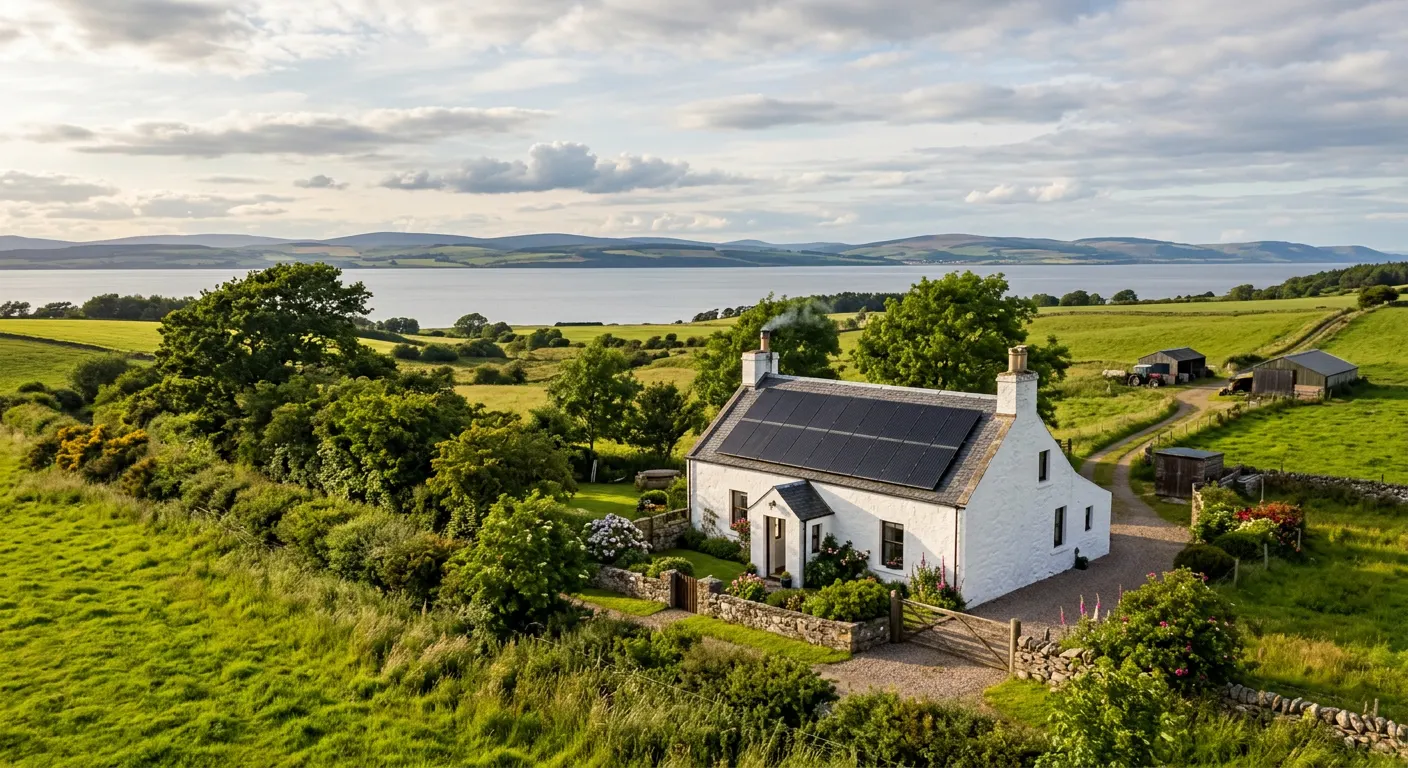
Solar in the Highlands
Is solar worth it in the Highlands?
Yes, for most Highland properties. Long summer days deliver strong generation, and many homes are off the gas grid, making self-generated electricity more valuable. A battery is the key that unlocks the value by storing summer surplus for the evenings and shorter winter days when you need it most.
Key facts
- Highland solar works hardest in summer: over 18 hours of daylight in June.
- A battery lifts self-consumption from 30–40% to 60–80%.
- Off-gas properties benefit most from displacing oil, LPG, and electric heating costs.
- A typical 4 kWp system in Inverness generates around 3,400–3,600 kWh per year.
- East-west roof splits suit self-consumption better than a single south face.
- We install through MCS-certified partners.
- Finance: interest-free credit up to £30,000, subject to status.
Last updated: November 2026
Solar in the Highlands is not the same proposition as solar in southern England. The latitude changes the shape of the year: you get dramatically more daylight in summer and noticeably less in winter. The question of whether it is worth it comes down to how well your system captures that summer surplus and how much of it you can actually use.
For most Highland homes the answer is yes — especially if you pair panels with a battery and you heat with anything other than mains gas.Interest-free credit up to £30,000, subject to status. To see exact numbers for your property, use the quote form on this page and our installer partner will arrange a no-obligation survey.
Get your quote
No obligationNo obligation. Our installer partner calls within 2 hours.
Do the long summer days make up for the short winter ones?
In summer, yes — and then some. Inverness sees over 18 hours of daylight in June, and a well-oriented system can generate well above typical household daytime demand. The trade-off is December, with around seven hours of low, often overcast daylight. The annual picture balances out: a typical 4 kWp system in Inverness generates around 3,400–3,600 kWh per year.
Inverness receives around 3.1–3.3 peak sun hours per day annually. Summer days are exceptionally long (over 18 hours of daylight in June), partly compensating for shorter winter days. The east-facing Highland capital gets less rainfall than the west coast, which helps panel performance. A typical 4 kWp system in Inverness generates around 3,400–3,600 kWh per year. The east-facing Highland capital gets less rainfall than the west coast, which helps keep panels clean and performing. The practical implication is that your system does the heavy lifting from April to September, and a battery is what makes that surplus useful instead of exported cheaply.
Why does battery storage matter so much in the Highlands?
Because the generation and demand curves do not line up. Solar peaks in summer when heating and lighting demand is lowest; demand peaks in winter evenings when generation is minimal. A battery bridges that gap by storing daytime surplus so you use it after dark instead of buying from the grid.
Without a battery, a typical Highland home uses only 30–40 per cent of its solar directly — the rest is exported at a low rate. With battery storage, self-consumption rises to 60–80 per cent. Every kWh you store and use yourself displaces a grid import at 24–30p, which is worth considerably more than exporting it. For a deeper look, see our guide to battery storage in the Highlands.
Summer generation
Over 18 hours of daylight in June. A well-oriented system overproduces against daytime demand.
Self-consumption
A battery lifts usable solar from 30–40% to 60–80% of what you generate.
Import displacement
Each stored kWh displaces a grid import at 24–30p rather than exporting at a lower rate.
Is solar worth it if your Highland home is off the gas grid?
Often, yes — and the maths is more favourable than for gas-heated homes.Many properties in the surrounding Highlands are off the gas grid, making solar-plus-battery or solar-plus-heat-pump combinations particularly relevant. These properties often have higher energy costs and benefit most from self-generation.
Properties heating with oil, LPG, or electric storage pay more per unit of energy than mains-gas homes. That means every kWh of self-generated solar that displaces a bought unit saves you more. Combined with a heat pump, solar-plus- battery can make a substantial dent in the running costs of an off-gas Highland property. If your home is in a rural IV postcode, this is likely the strongest argument for going solar.
For area-specific guidance, see our pages on the Black Isle and Drumnadrochit and Glen Urquhart, where off-gas properties are common.
What about roof orientation and self-consumption?
A south-facing roof at 30–40 degrees generates the most total energy, but an east-west split can actually serve self-consumption better. East-facing panels produce more in the morning, west-facing more in the afternoon and evening, which aligns generation with when a household is actually using power.
Inverness has a mix of traditional slate roofs (Victorian and Edwardian stone-built homes in Crown, Dalneigh, Hilton), modern concrete tile (post-war estates and new-builds in Culloden, Westhill, Inshes), and some corrugated metal on older agricultural properties. Slate roofs often require specialist mounting brackets to avoid cracking. South-facing pitches of 30–40 degrees are ideal but east–west splits work well for self-consumption. The mix of traditional slate and modern concrete tile across Inverness and the surrounding Highlands means mounting requirements vary, but most roof types are suitable. Our installer partner assesses orientation, pitch, and shading during the survey and advises on the layout that best matches your usage pattern.
What is the standard system and what does it cost?
Our standard domestic system is 12 × AIKO Comet 500 W black-on-black, paired with a Hanchu ESS hybrid inverter and a Hanchu LiFePO4. Included as standard is included, and the full system is installed through our MCS-certified partner.
The standard system price is £12,500–£13,500 fully installed. Warranties include 30-year performance warranty (above 90% output at year 30, approximately 0.4% per year degradation), 10-year inverter warranty, and 10-year battery warranty. An insurance-backed guarantee through the independent warranty association, covering the system if the installing company ceases trading is also included. For the full specification breakdown, see our solar panel systems page. Interest-free credit up to £30,000, subject to status.
Panel warranty
30-year performance warranty (above 90% output at year 30, approximately 0.4% per year degradation)
Battery warranty
10-year battery warranty
Inverter warranty
10-year inverter warranty
Insurance-backed guarantee
Insurance-backed guarantee through the Independent Warranty Association, covering the system if the installing company ceases trading
So, is solar worth it in the Highlands?
For most properties, yes — with two conditions. First, pair the panels with a battery so you actually use the surplus you generate. Second, be realistic about the seasonal pattern: solar in the Highlands is a long-summer, self-consumption proposition, not a year-round generation one. If you are off the gas grid, the case is stronger still.
The best way to answer the question for your specific home is a no-obligation survey. Our installer partner assesses your roof, orientation, and energy use, then models expected generation and self-consumption so you can decide based on real figures. Fill in the form at the top of this page, or call us directly.
Get real numbers for your home
The guidance on this page is general. Your actual generation and self-consumption depend on your roof, orientation, shading, and energy use. Fill in the form at the top of this page, or call us, and our installer partner will arrange a no-obligation survey at your Highland property.
Frequently asked questions
Is solar worth it in the Highlands compared to the rest of the UK?
Yes. The Highlands compensate for shorter winter days with exceptionally long summer daylight, and many properties are off the gas grid, making self-generation more valuable. A battery is central to the value case because it stores surplus summer generation for use in the evening and through darker months.
How much solar do Highland homes generate in winter?
Winter output is low. Inverness sees around seven hours of daylight in December, much of it overcast, so a typical system generates a fraction of its summer peak. This is why a battery and realistic expectations matter: solar in the Highlands is a long-summer, self-consumption proposition rather than a year-round generation one.
Does battery storage make solar worth it in the Highlands?
For most Highland homes, yes. Without a battery, self-consumption sits around 30 to 40 per cent because generation peaks in summer when demand is low. A battery lifts that to 60 to 80 per cent by storing surplus generation so you use it in the evening instead of buying from the grid at 24 to 30 pence per kWh.
Is solar worth it for off-gas Highland properties?
Many properties in the surrounding Highlands are off the gas grid, making solar-plus-battery or solar-plus-heat-pump combinations particularly relevant. These properties often have higher energy costs and benefit most from self-generation. These homes pay more per unit of energy for oil, LPG, or electric heating, so every kWh of self-generated solar that displaces a bought unit saves more than it would for a gas-heated home. Solar-plus-battery is particularly relevant here.
What about properties in the Cairngorms or further north?
Properties in Aviemore and the Cairngorms benefit from the same long summer days, though some sit within the National Park boundary where planning rules differ. Further north in Caithness, summer generation is strong but coastal exposure means marine-grade hardware matters. Our installer partner advises on the right specification for your location.
Is finance available for a solar and battery system in the Highlands?
Interest-free credit up to £30,000, subject to status. This spreads the cost of a full solar-plus-battery system without interest charges. Ask about current terms when you request a quote.
How do I find out if solar is worth it for my property?
Request a quote and our installer partner will carry out a no-obligation survey, assessing your roof orientation, shading, and energy use. They will model expected generation and self-consumption for your specific property so you can decide based on real numbers, not averages.
Learn more about solar in the Highlands
- Full solar panel system specification — panel, inverter, and battery details for our standard Highland install.
- Battery storage in the Highlands — why a battery is central to making Highland solar worth it.
- Warranties and guarantees explained — what is covered by the panel, inverter, battery, and insurance-backed guarantees.
- How the installation process works — from first call to switch-on for Inverness and Highland properties.