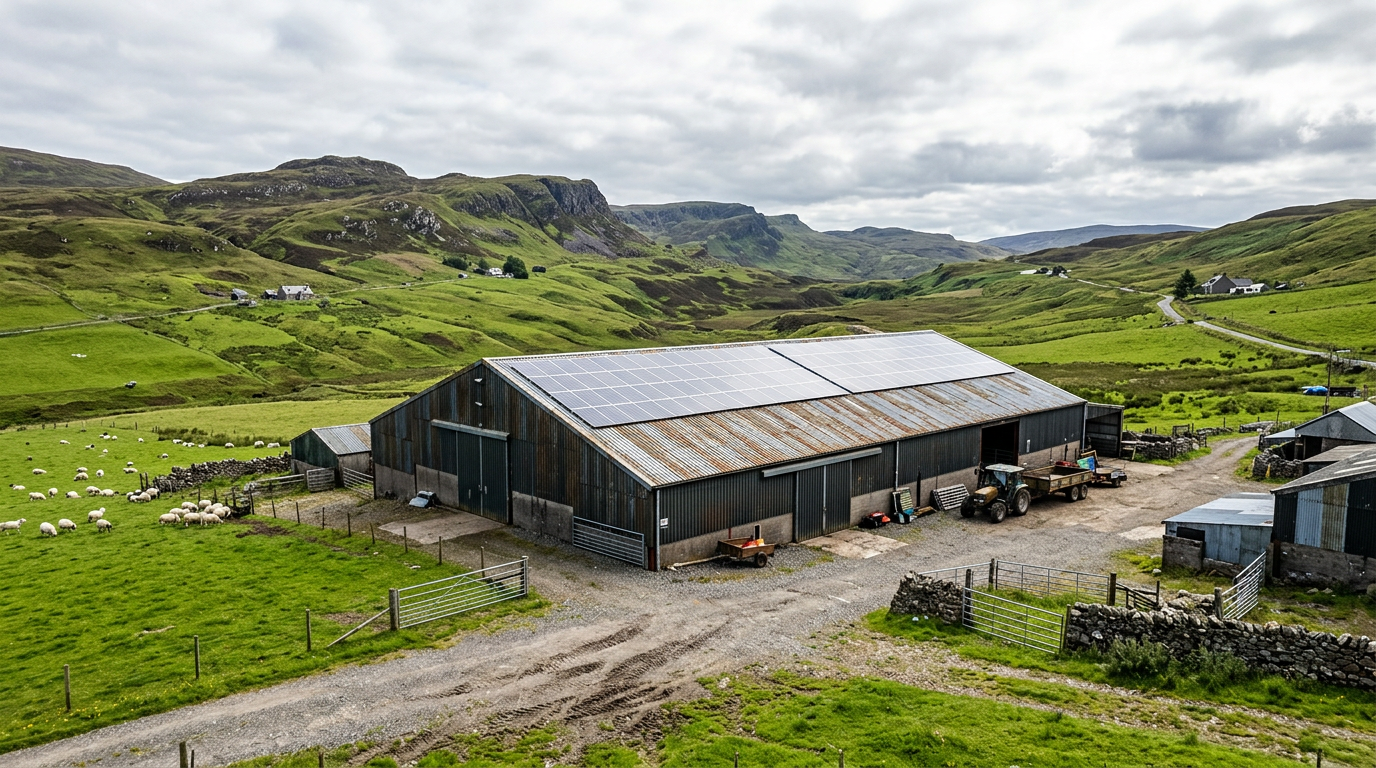
Solar for farms and rural properties
Are solar panels worth it for farms and rural properties in the Highlands?
Yes, for most Highland farms, crofts, and rural businesses. Large barn roofs and outbuildings give you the space to generate serious amounts of electricity, and many rural properties are off the gas grid, so self-generated power is worth more. Add a battery and export income, and the business case is strong.
Key facts
- Barn roofs and outbuildings offer large, unobstructed surfaces for solar arrays.
- Many Highland farms and crofts are off the gas grid, making self-generation more valuable.
- A battery lifts self-consumption from 30–40% to 60–80% of what you generate.
- Export tariffs pay for surplus electricity sent back to the grid.
- Highland summer daylight runs over 18 hours in June, driving strong generation.
- We install through MCS-certified partners.
- Interest-free credit up to £30,000, subject to status.
Last updated: November 2026
Farms and rural properties in the Highlands are some of the strongest candidates for solar. You tend to have the two things that make solar worthwhile: generous roof area on barns and outbuildings, and energy demand that is either high enough to use what you generate or remote enough that grid electricity is your main or only option.
Many properties in the surrounding Highlands are off the gas grid, making solar-plus-battery or solar-plus-heat-pump combinations particularly relevant. These properties often have higher energy costs and benefit most from self-generation. For crofts, farms, distilleries, and other rural businesses, the question is less about whether solar works and more about how to size a system that matches your demand and your roof. To get real numbers for your premises, use the business form on this page and our installer partner will arrange a no-obligation survey.
Business enquiry
No obligationTell us about your premises. We will call within 2 hours.
Why do barn roofs suit solar so well?
Highland farms typically have large agricultural buildings with broad, clear-span roofs and few dormers, chimneys, or vents in the way. That gives you a big, flat surface at a consistent pitch — ideal for fitting a dense panel array. Steel profile and corrugated roofs accept standard mounting systems, and a south or east-west facing barn can carry a substantial system.
Compared to a domestic roof, where shading from trees and neighbouring buildings is often the limiting factor, a barn roof is usually free of obstructions and positioned in the open. That means better irradiance and cleaner generation curves. Our installer partner surveys the structure to confirm load capacity and orientation before recommending a layout, because an array large enough to matter on a farm needs a roof that can carry it.
What makes off-gas rural properties a strong case?
Many properties in the surrounding Highlands are off the gas grid, making solar-plus-battery or solar-plus-heat-pump combinations particularly relevant. These properties often have higher energy costs and benefit most from self-generation. When your only heating options are oil, LPG, or direct electric, each unit of self-generated solar that you use instead of buying from the grid saves you more than it would for a mains-gas property. The gap between what you pay for energy and what solar costs to produce is wider, so the payback is shorter.
Add a battery and that advantage compounds. Instead of exporting surplus generation at a lower rate, you store it and use it in the evening or through darker months, displacing expensive bought energy. For crofts and small farms where energy is a significant running cost, solar-plus-battery is one of the most practical ways to reduce exposure to volatile fuel prices. You can read more about the storage side on our battery storage page.
Roof area
Barns and outbuildings offer large, unobstructed surfaces for dense panel arrays.
Self-consumption
A battery lifts usable solar from 30–40% to 60–80% of what you generate.
Export income
Surplus electricity sent to the grid earns money through an export tariff.
Can a croft or farm earn money from exporting solar?
Yes. If your premises have a grid connection and you generate more than you use, the surplus can be exported and sold through an export tariff. For a croft with modest demand and a generously sized array, export income can be a meaningful part of the business case. The value depends on your connection agreement and the tariff you choose.
G98/G99 application via SSEN before installation. Systems up to 3.68 kW single-phase typically qualify for simplified G98 notification; larger systems require G99 engineering study, which can take 6–12 weeks in the Highlands due to grid constraints. This matters for rural installations because larger arrays often trigger a G99 application rather than a simple G98 notification, and grid capacity can be constrained in remoter parts of the Highlands. Our installer partner handles the DNO application as part of the project and advises on what connection you can expect before you commit.
How does solar work for Highland distilleries?
Distilleries run energy-intensive processes — pumps, lighting, refrigeration, and bottling lines — much of it during daylight hours when solar generates. A roof-mounted array on a distillery building or warehouse can offset a meaningful share of that daytime demand, and a battery extends the benefit into evening and overnight production. Because distillery roofs are usually large and uncomplicated, they are well suited to commercial-scale arrays.
The key is matching the system to your load profile. Our installer partner models your consumption pattern and expected generation to size an array that maximises self-consumption rather than over-sizing for export. For a broader look at commercial solar, see our commercial solar page.
What about ground-mounted solar for land you are not using?
If your roofs are unsuitable or you need more capacity than they can carry, a ground-mounted array on unused paddock or grazing land is an option. Ground-mounted systems can be sized to match higher demand and oriented for maximum generation, and they avoid any structural limits of existing buildings. They do, however, usually require planning permission from The Highland Council and a suitable grid connection.
Most domestic roof-mounted solar does not need planning permission under permitted development rights. Exceptions: listed buildings (Highland Council has over 1,700), conservation areas (Inverness city centre, Crown, Culduthel), and buildings in the Cairngorms National Park boundary. Applications to The Highland Council planning department required in these cases. Our installer partner advises on the planning position for your site and handles the DNO application. For crofts with available land but limited roof space, a ground-mounted array can be the difference between a token system and one that genuinely moves the dial on your energy costs.
What warranties and finance apply to rural and commercial installs?
We install through MCS-certified partners, and the same warranty framework applies to rural and commercial systems: 30-year performance warranty (above 90% output at year 30, approximately 0.4% per year degradation), 10-year battery warranty, and 10-year inverter warranty. An insurance-backed guarantee through the independent warranty association, covering the system if the installing company ceases trading is also included.
Interest-free credit up to £30,000, subject to status, is available for eligible rural businesses. You can see the full system specification on our solar panels page and read about what is covered on our warranties and guarantees page.
Panel warranty
30-year performance warranty (above 90% output at year 30, approximately 0.4% per year degradation)
Battery warranty
10-year battery warranty
Inverter warranty
10-year inverter warranty
Insurance-backed guarantee
Insurance-backed guarantee through the Independent Warranty Association, covering the system if the installing company ceases trading
Get real numbers for your farm or rural property
The guidance on this page is general. Your actual generation, self-consumption, and export potential depend on your roof area, orientation, shading, load profile, and grid connection. Fill in the business form at the top of this page, or call us, and our installer partner will arrange a no-obligation survey at your Highland premises.
Frequently asked questions
Do barn roofs make good sites for solar panels?
Yes. Many Highland farms have large, clear-span barn roofs with few obstructions, which suit dense panel arrays and make the most of available space. Steel and corrugated roofs accept standard mounting systems, and a barn with a south or east-west orientation can carry a substantial array. Our installer partner surveys the structure to confirm load capacity and orientation before recommending a layout.
Can a croft generate income from exporting solar?
A croft with a suitably sized array and a grid connection can earn money from exported electricity through an export tariff. The value depends on your connection agreement and the tariff you choose. Because croft demand is often modest relative to the roof area available, export income can be a meaningful part of the business case for rural installations.
Is solar worth it for an off-gas rural property?
Off-gas rural properties usually pay more per unit of energy for oil, LPG, or electric heating, so every kWh of self-generated solar that displaces a bought unit saves more than it would for a mains-gas property. Combined with a battery to store daytime surplus, solar is particularly relevant for off-gas crofts and farms across the Highlands.
How does solar work for a Highland distillery?
Distilleries use large amounts of electricity for pumps, lighting, and refrigeration, much of it during the day when solar generates. A roof-mounted array on a distillery building can offset a meaningful share of daytime demand, and a battery can extend the benefit into evening production. Our installer partner models your load profile and generation to size a system that matches your usage.
Is finance available for commercial solar on a farm or rural business?
Interest-free credit up to £30,000, subject to status. This spreads the cost of a solar and battery installation for eligible rural businesses. Ask about current terms when you request a quote, and our installer partner discusses finance alongside your written proposal.
What about planning permission for barn-mounted solar in the Highlands?
Most domestic roof-mounted solar does not need planning permission under permitted development rights. Exceptions: listed buildings (Highland Council has over 1,700), conservation areas (Inverness city centre, Crown, Culduthel), and buildings in the Cairngorms National Park boundary. Applications to The Highland Council planning department required in these cases. Ground-mounted arrays and larger commercial systems may require planning permission from The Highland Council, particularly in conservation areas, on listed buildings, or within the Cairngorms National Park boundary. Our installer partner advises on the planning position for your specific site as part of the survey.
How do I get a quote for solar on my farm or rural property?
Fill in the business form on this page or call us directly. We discuss your premises, energy use, and goals, and our installer partner arranges a no-obligation survey to assess roof area, orientation, and load capacity. You receive a written proposal with generation modelling and finance options so you can decide based on real figures.
Learn more about solar in the Highlands
- Commercial solar — how solar works for Highland businesses, farms, and distilleries.
- Battery storage in the Highlands — why storage is central to using what your array generates.
- Solar panel systems and pricing — the full specification for our standard install.
- Warranties and guarantees explained — panel, battery, inverter, and insurance-backed cover.
Last updated November 2026